
Reality Is The Real Power
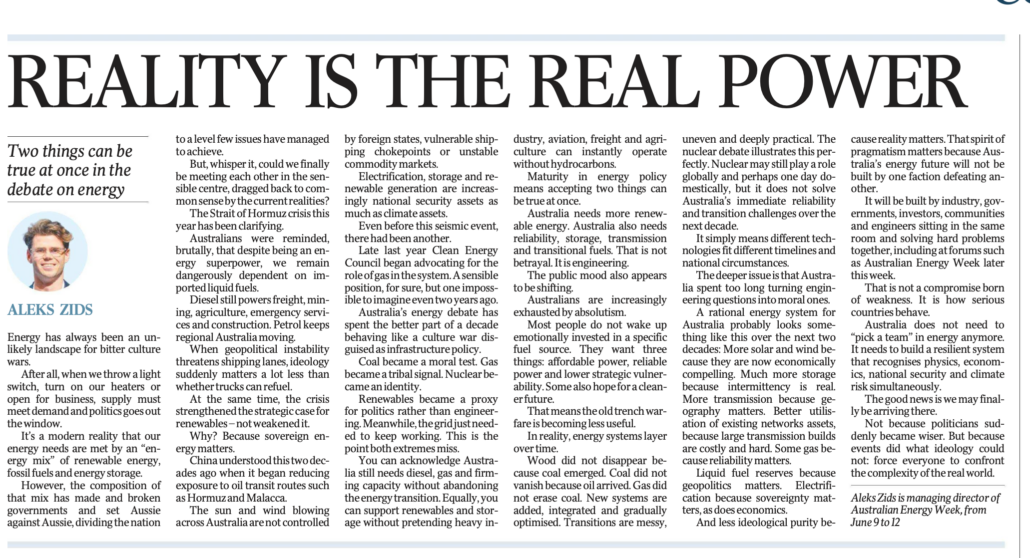
An incisive op-ed by Aleks Zids, the Managing Director of Australian Energy Week featured in the Australian on the eve of the big event.
It was great to once again work with Quest Events ahead of Australian Energy Week, and a pleasure to be the Official Communications Partner at the event.
Read his opinion piece, published in The Australian below.
By Aleks Zids
Australian Energy Week Managing Director
ENERGY has always been an unlikely landscape for bitter culture wars.
After all, when we throw a light switch, turn on our heaters or open for business, supply must meet demand and politics goes out the window.
It’s a modern reality that our energy needs are met by an “energy mix” of renewable energy, fossil fuels and energy storage.
However, the composition of that mix has made and broken Governments and set Aussie against Aussie, dividing the nation to a level few issues have managed to achieve.
But, whisper it, could we finally be meeting each other in the sensible centre, dragged back to common sense by the current realities?
The Strait of Hormuz crisis this year has been clarifying.
Australians were reminded, brutally, that despite being an energy superpower, we remain dangerously dependent on imported liquid fuels.
Diesel still powers freight, mining, agriculture, emergency services and construction. Petrol keeps regional Australia moving. When geopolitical instability threatens shipping lanes, ideology suddenly matters a lot less than whether trucks can refuel.
At the same time, the crisis strengthened the strategic case for renewables — not weakened it.
Why? Because sovereign energy matters.
China understood this two decades ago when it began reducing exposure to oil transit routes like Hormuz and Malacca.
The sun and wind blowing across Australia are not controlled by foreign states, vulnerable shipping chokepoints or unstable commodity markets. Electrification, storage and renewable generation are increasingly national security assets as much as climate assets.
Even before this seismic event, there had been another.
Late last year Clean Energy Council began advocating for the role of gas in the system. A sensible position, for sure, but one impossible to imagine even two years ago.
Australia’s energy debate has spent the better part of a decade behaving like a culture war disguised as infrastructure policy.
Coal became a moral test. Gas became a tribal signal. Nuclear became an identity. Renewables became a proxy for politics rather than engineering.
Meanwhile, the grid just needed to keep working.
This is the point both extremes miss.
You can acknowledge Australia still needs diesel, gas and firming capacity without abandoning the energy transition.
Equally, you can support renewables and storage without pretending heavy industry, aviation, freight and agriculture can instantly operate without hydrocarbons.
Maturity in energy policy means accepting two things can be true at once.
Australia needs more renewable energy.
Australia also needs reliability, storage, transmission and transitional fuels.
That is not betrayal. It is engineering.
The public mood also appears to be shifting. Australians are increasingly exhausted by absolutism.
Most people do not wake up emotionally invested in a specific fuel source. They want three things: affordable power, reliable power and lower strategic vulnerability. Some also hope for a cleaner future.
That means the old trench warfare is becoming less useful.
In reality, energy systems layer over time.
Wood did not disappear because coal emerged. Coal did not vanish because oil arrived. Gas did not erase coal. New systems are added, integrated and gradually optimised. Transitions are messy, uneven and deeply practical.
The nuclear debate illustrates this perfectly.
Nuclear may still play a role globally and perhaps one day domestically, but it does not solve Australia’s immediate reliability and transition challenges over the next decade.
It simply means different technologies fit different timelines and national circumstances.
The deeper issue is that Australia spent too long turning engineering questions into moral ones.
A rational energy system for Australia probably looks something like this over the next two decades:
More solar and wind because they are now economically compelling.
Much more storage because intermittency is real.
More transmission because geography matters.
Better utilisation of existing networks assets, because large transmission builds are costly and hard.
Some gas because reliability matters.
Liquid fuel reserves because geopolitics matters.
Electrification because sovereignty matters, as does economics.
And less ideological purity because reality matters.
That spirit of pragmatism matters because Australia’s energy future will not be built by one faction defeating another.
It will be built by industry, governments, investors, communities and engineers sitting in the same room and solving hard problems together, including at forums like Australian Energy Week later this month. That is not a compromise born of weakness. It is how serious countries behave.
Australia does not need to “pick a team” in energy anymore. It needs to build a resilient system that recognises physics, economics, national security and climate risk simultaneously.
The good news is we may finally be arriving there.
Not because politicians suddenly became wiser.
But because events did what ideology could not: force everyone to confront the
complexity of the real world.
Aleks Zids is Managing Director of Australian Energy Week, June 9 to 12.


